The Matrix: Inventive, Interesting, and Iconic

Credits: Google

By Charmaine Quizon

Directors: Lana and Lilly Wachowski

Hollywood has been and is still being dominated by science fiction films. And who would not be fascinated to watch fictional characters as they explore their destiny and go about on their adventure of life? If you are a fan of this genre, you should never miss the exceptional film made by the Wachowskis- The Matrix. This is a trilogy with a cyberpunk plot that revolutionized the face of science fiction films. This is a story of Thomas Anderson or Neo played by Canadian actor Keanu Reeves, an outwardly ordinary software programmer in the morning and a hacker in the evening who found himself to be with a group of rebels brawling with super agents in saving humanity from a false reality world called The Matrix. Now this may sound so technical and filled with action-packed scenes but the film is more than that. It has a lesson that life is about making choices shown through myriads of symbolism. This motion picture has proven its greatness with a number of recognition like Best Visual Effects, Best Science Fiction film, and Movie of the year in the year 1999. Considering it was released 2 decades ago, each element that made up this movie is sure worth your time.

Credits: Google

The movie is inventive, interesting, and iconic.

The theme is inventive. The film incorporated referents in enriching spectator’s narrative experience. On this movie, you’ll get to be caught on some familiar object or idea that would seem unexpected but were properly executed.

The plot is interesting. The explanation of Neo’s dual nature and his search for truth in the beginning of the story were unfolded as the story progresses. Puzzling scenes make sense as the plot developed.

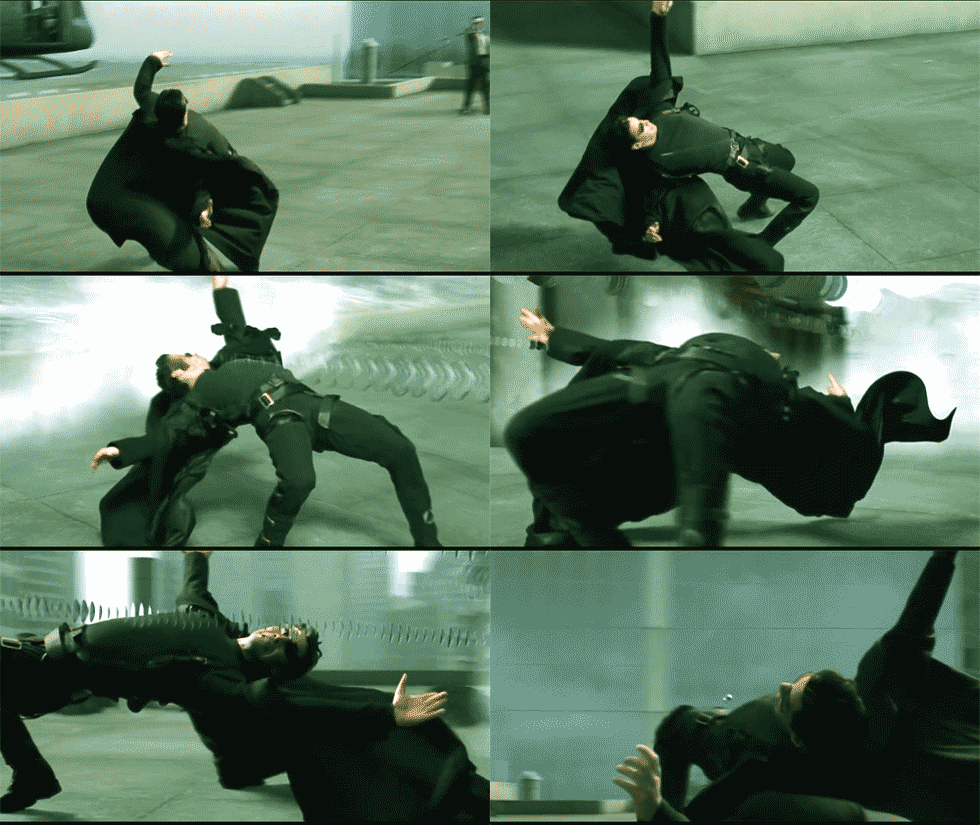
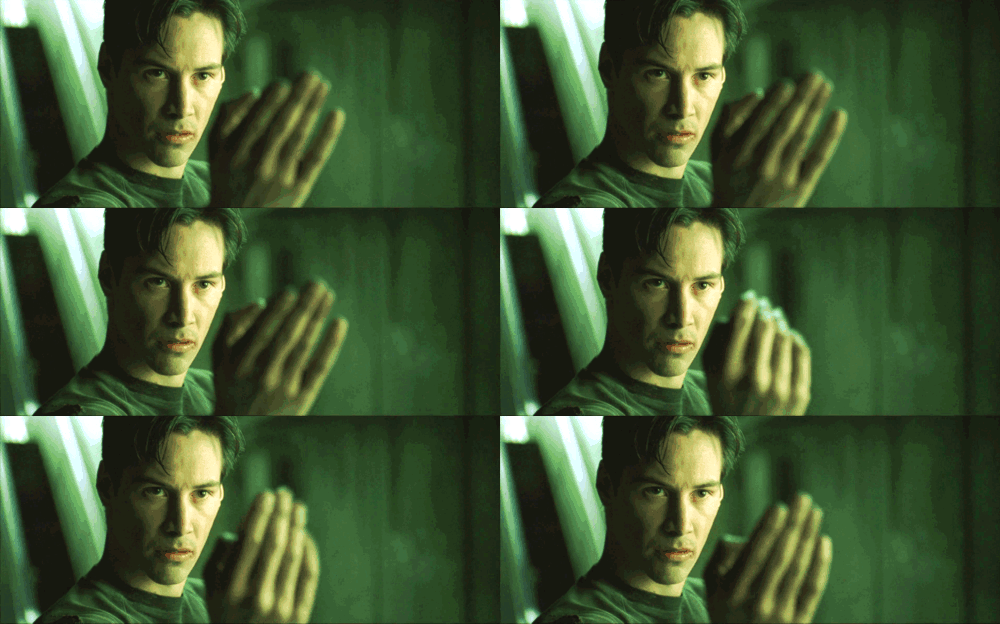
The actors’ performances are iconic. Aside from Keanu Reeve’s natural performance as Neo endowed with superhuman skills as he goes through an adventure of saving humanity from the virtual reality the Matrix, the casts’ costumes were another thing to look forward too. Black skintight coats with shades of lead characters set this movie apart from the rest. The action-packed scenes that would make your adrenaline pump is something to look forward too. All the movement defying gravity from jumping from a high-rise building to another one, free movement of walking on walls, and the iconic ultra slow motion of stream of bullets shunned by Neo by bending backwards were all visual treat.

Credits: Google

The Matrix (1999) is followed by a sequel The Matrix Reloaded and The Matrix Revolutions both released in 2003.

ultimate and intense

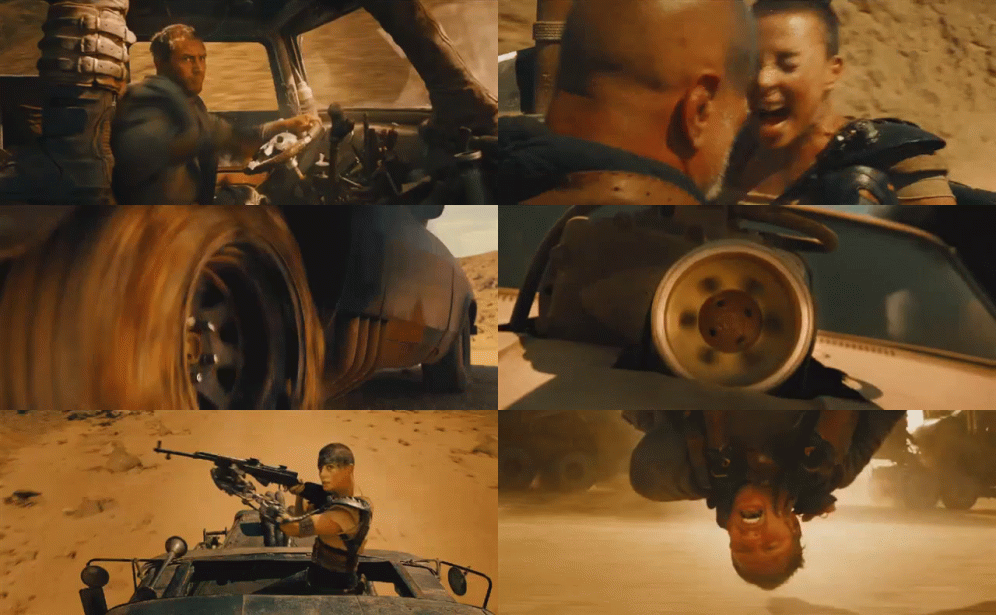
Mad Max: Fury Road is a post-apocalyptic film released in 2015 and is basically the pinnacle of action films (I mean, I may be wrong because I’m not really a fan of anything action). It was written, produced and directed by George Miller, a veteran Australian filmmaker and is considered as one of the best directors of our time. As mentioned above, the film is set in a post-apocalyptic manner where everything is scarce and displayed an intense and aggressive amount of masculine pride throughout the whole duration of the film.

To tell you honestly I didn’t understand what was happening in the beginning of the film and was at lost for words about how crazy everything was. Everyone was screaming words I can not understand, everyone seemed like they were in a brawl. But, I can’t believe I’m saying this but I loved it and I appreciated action films and all the preparations and the hard work they’ve put into this film. It was an action packed 2 hours, it will HONESTLY leave you wanting for more. Also, everyone was fit for their roles and made everything work. Also, a great thing about Mad Max is that it was actually fast paced, something a lot of action filmmakers fail to do – because some of the action movies I’ve watched are dragging and it’ll bore you till the next scene happens. But, somehow I failed to appreciate some of the scenes because of it being fast paced.

What I realized at the end of the film was that it seemed like men can not live without sexual partners in far, post-apocalyptic places anymore or any place for that matter. In addition, I also feel like Mad Max has set standards in action films – especially, the stunts and the car chases. Also, based on the articles I’ve read about the film, it was stated that they didn’t use CGI in some of the scenes and it amazed me how they’ve managed to pull everything off despite not using CGI. I also thought that it puts other action films to shame (just kidding! haha).

Over all, I appreciated the film and the message it conveys. I also highly recommend this film to anyone who haven’t watched it and bask in its full glory.

Myka Andrea ¯\_(๑❛ᴗ❛๑)_/¯

One Futureworld

Mendoza, Khamylle Anne E.

The Matrix

The film was released by The Wachowskis in 1999. The characters of the film were Laurence Fishburne as the witty Morpheus, Carrie-Ann Moss the strong woman, and of course, the main character—Keanu Reeves who played the lost and confused Neo. In this film, Reeves executed a full fledged and much reformed character. The film entails impressive special effects manifesting the battle between good and evil. It focuses on the idea of what reality truly means. Personally, I think the film strives to elevate the viewers to think that reality is confusing, and that people are living in a world full of dreams. Indeed, the film uplifts the question why reality is our enemy. Hence, it demonstrates the purpose of human existence. On the other hand, the acting in this movie is SUPERB! It seems like the characters played by the right actors.

In fact, I love how the film brought off the beauty of fighting scenes such as the gun fighting! And the actions executed were not the basic ones, I think the actors went through a tough months of training to learn Kung-Fu or Martial Arts or something from scratch to look those kicks and punches quite choreographed. And I think those efforts absolutely helped the film display a more computer generating setting. 

In addition, another attribute of the film I liked the most was its choice of music. Most especially during the fight scenes wherein fast tempos were used. Not only that, the film has a variety of songs as well… from heavy metal to classical rhythms. The costumes, on the other hand, are interesting too! Each costume symbolizes different groups.

Above all, I think The Matrix stands out from other film considering the science fictions, since it has an intense fighting scenes combined with an appropriate music and dramatically stunning special effects. 

Blue Pill or Red Pill? : The Matrix

Directed by: The Wachowski Brothers
Released Date: March 31, 1999 (United States)
Running Time: 136 Minutes

The matrix is a Fantasy/ Science Fiction film directed by Wachowski brothers, made a record of 463.5 Million US dollar in 1999, again gave me a strong impression even though I have watched the film years ago. Inviting me to the new world “matrix” made me to feel as if I also might have an ability like Neo.

Keanu Reeves who starred as Neo is the one who took biggest benefits by this film since this film became one of his remarkable filmography where people started to recognize him as an action movie star.


Thomas A. Anderson , who is living a double life as an ordinary computer programmer at day time and a hacker name as “Neo” at night time always had a question about reality. A man named Morpheus approaches him and leads him to the new world “The Matrix”. When Morpheus gave him a choice to choose either blue pill and the red pill, Anderson had a choice not to enter the world and live as an ordinary computer programmer but Anderson chose the red pill and began his journey inside the real world, starting a new life with his new name “Neo.”

After accepting the red pill, Neo was born again as hairless, naked and weak human being and Morpheus explains robots made a war against their creator, human beings and now the world is controlled by them. There he now lives and work with his love Tritiny who first approached him when he was working as a computer programmer in the previous world.


“This is your last chance. After this, there is no turning back. You take the blue pill – the story ends, you wake up in your bed and believe whatever you want to believe. You take the red pill – you stay in Wonderland and I show you how deep the rabbit-hole goes.”

This film, “The Matrix” where it applied aspect of Semiotic code. Actually even though with no intention of putting semiotic elements in the film, I believe that the film eventually has an existence of it.
The matrix is more sided on connotative aspect rather than denotative, where it is more related to cinematographic elements, creating the moods, motives and other meanings by the visual and auditory elements. Connotative meaning extends over the denotative meaning. Like for example, With the scene of Morpheus offering two different pills, by just simply looking at the pills in denotative meaning, it is a medicine. However, seeing it by connotative perspective, it is the main linkage to the world “matrix” (pills containing other meanings in the film). 

The world matrix now in 2019 may be understood easily and it is true that the atmosphere of the film is now getting closer to the reality of this world. However, considering that this film was made in year 1999, the visual elements and the concept idea itself of the film is just amazing. It is like putting an imagination with in the screen but that imagination couldn’t be performed considering the year 1990’s. Not the story nor the action was boring. While watching this film, I couldn’t feel any awkwardness in terms of editing skill, actions and the cinematography itself. Especially the bullet dodging scene, is still remembered by millions of people as the most tremendous and memorable scene until now. The harmony between skills of camera angle, performance and the editing skills made this movie as Blockbuster.

Famous bullet dodging scene

With fulfilling the aspects of action film, “The Matrix” somehow showed the negative side of rapid human development during the late 1990’s where The Wachowski Brothers made the worries become true in the film with perfect combination of story and cinematography. It is also true that it made millions of people enjoy and made them enter the new world: The Matrix. I personally liked the film where I imagined myself dodging a bullet like Neo, loved the film with full of action scenes.

Written by
“Baek, Jin Wook”

Not an animal nor a human… such an imperfect world, an imperfect life.

Mark Gil Sabandal

Genre: Action & Horror, Science Fiction & Fantasy

Directed By: Stephen Norrington

Written By: David S. Goyer

Release Date: August 21, 1998

Runtime: 120 minutes

With so many different types of action/fantasy in the film industry, and fantasy movies are mostly made of myths and folklore, Norrington’s unique technique in directing a film and Goyer’s creative mind showcased a well-crafted story titled Blade. Norrington and Goyer’s take on the story’s screenplay along with the portrayal of its characters amidst great visuals from scene to scene.

Blade (1998) is one of the films in the 19th century that uses advance technologies in order to produce amazing shots and expand creativity which results to capturing all actions and fighting scenes perfectly and amazingly. Considering Snipes background knowledge in martial arts, the action-packed movie keeps the viewers on their feet by not missing any scenes especially all the fighting scenes that appeared natural and well-choreographed. The story came from the adaptation of the comic book produced by Marvel Comics with its same title. Blade (portrayed by Wesley Snipes) is categorized as a dhampir; a half-human and a half-vampire also known as a “day walker” who hunts vampires. The first shot begins when Blade’s mother was bitten by a vampire during her pregnancy period and made her and Blade vampire too. The movie then fast-forward to the gist of the story, Blade hates vampire because of what happened to his mother and made it his mission to hunt and kill vampires. Blade’s main opponent is Deacon Frost (portrayed by Stephen Dorff), a human who turned vampire, and he is too greedy for power that he will do everything just to be on top and always feel that no one can outdo him even Blade. He planned to disestablish the vampire council by being the very first person to find the ancient vampire texts, and use it to unleash “La Magra” or the blood god, thus, enslave people to be the main source for blood milking.

Although Blade is not a full blown vampire and possessed all the power of vampires but none of their weaknesses, he is still in need of blood because of vampires’ nature – they suck blood and consider it as their main source of food. Blood for vampires mean everything. It boosts their energy and makes them feel relief. One of the remarkable scenes is when Blade injects a vaccine to prevent himself from craving to his temptation of drinking blood. Thanks to his friend Abraham Whistler (portrayed by Kris Kristofferson) whom he considers as a mentor and help him create an antidote to stop him from his desire of drinking blood and for not being a fully vampire.

As the story unfolds, Blade went to Frost’s penthouse so he can rescue Dr. Karen (portrayed by N’Bushe Wright) who believes that there is still a possible solution to help Blade and completely remove his vampire blood in his body and live a normal life but that experiment may take years, and what makes that scene extra especial is when he found out that his mother is still alive and revealed that the vampire who bit her was Frost.   

The visual aspect of the film uses Formalism approach which deals with the extravagant way in editing the film. There are notable elements that come together in making the film as it is. Considering its cinematography, Blade (1998) uses a variety of camera angles that heighten the portrayal of the characters and deepen the happenings in the film. Most scenes are well-executed due to the editing style. Colors of each scene appropriate transcend the atmosphere of the film. Say for example, one of the very first scenes in the film is when to a Blade bar. He visualize that all the people in that place are too thirsty and desperate to drink blood.

Another good example is Blade’s last fighting scene with Frost that shows the subject of the scene is always in the center position which helps viewers avoid eye shifting in another part of the frame even with its has multiple cuts. Thus, keeping the viewers eyes on the most important parts of the film.

Given that most scenes are composed of fighting scenes, the film as a whole mostly made use tracking shots which make most of the fighting scenes easy to follow and visually pleasing to the viewer even when most of the scenes were bloody. The only thing that I think of as a downside of this film is the language used. There are some instances that Blade’s choices of words are considered as “below the belt” which might be taken as foul. Parental guidance for children is strongly suggested since the theme of the film might come across as greedy or in need of too much power.

References:

Retrieved from https://en.wikipedia.org/wiki/Blade_(film)

Retrieved from http://putlockertv.ws/watch/zGOAX6vK-blade-1998.html

Retrieved from https://www.youtube.com/watch?v=bbV3DAe8KnE

Avengers: Infinity War

The Beginning of the End

Rooted in the formalist theory of film, this critical analysis aims to explore the technical aspects of the critic’s chosen film, Avengers: Infinity War. The film heavily incorporated the use of computer-generated visual effects to complement and emphasize the tragic story of the film. Furthermore, the special effects augmented the emotional weight of the story and its action sequences. For starter, Victoria Alonso, one of the film’s executive producers, said that the film has almost 3000 shots and that there are about 2900 visual effects shots. This means that the 96% of the shots of the film had visual effects (Singer, 2018); for every 25 shots, only 1 does not possess computer-generated imagery (CGI).

Formalist films are those that possess stories styled and poised to create its own reality with intricate and detailed sets that result into an elaborate mise-en-scène, and uses special visual effects with no intentions to imitate reality (Fusco, 2017).

Avengers: Infinity War is the sequel to The Avengers (2012) and The Avengers: Age of Ultron (2015) and it is the nineteenth film in the Marvel Cinematic Universe (MCU). The film features a crossover of “The Avengers” also known as the “Earth’s Mightiest Heroes”, and the “Guardians of the Galaxy”. They work together for a united cause—to prevent their common foe, Thanos, from acquiring the “Infinity Stones”—the six powerful elemental crystals that each control an essential aspect of existence, namely: space stone, reality stone, power stone, soul stone, mind stone, and time stone.

The film begins with Thanos hijacking a spaceship which houses the last survivors of Asgard. The scene follows with the children of Thanos, Maw and Obsidian, attacking New York City in order to acquire the Time Stone from Doctor Stephen Strange. If you will juxtapose the two scenes, they have two discrete mise-en-scènes—the former is in “space” and the latter is just in New York City; however, they were both filmed inside the studio, both made possible by computer-generated imagery.

In reference to the New York City action scenes, visual effects supervisor Patric Roos said, “The work was a real mix of full CG shots, plate shots, FX, set extensions, magic spells and a lot of character work”. The scenes of Wanda Maximoff/Scarlet Witch and Vision’s fight with the men of Thanos’ Black Order in Edinburgh, Scotland where Natasha Romanoff/Black Widow, Steve Rogers/Captain America, and Falcon appears, were actually shot in Scotland. Despite such scene being shot ground zero, production designer Charles Wood still had to build extra items, for example, a coffee shop, and had to incorporate additional visual effects in order to add a “Kafkaesque” or an unpleasant feeling, as per film director Joe Russo’s request. The biggest fight of the Marvel’s “biggest” and “most ambitious” crossover happened at the modern, technologically advanced, and vibranium-ran country Wakanda.

Joe Russo and Anthony Russo, the film’s directors had to reach out to Ryan Coogler, the director of Black Panther, in order to build the mise-en-scène for Wakanda. The film’s art department had to carve an artificial river and install artificial trees and vegatation to achieve the look of Africa. The scenes of Wakanda were shot in a 3,238-hectare farm in Chattahoochee Hills, Georgia. Moreover, director Anthony Russo said “Charlie Wood and his art department actually carved an artificial river through the center of this field and we had a gigantic pump that could do like 30,000 gallons a minute.” and that speaks volumes on how elaborate the Wakanda scene is. The battle in Wakanda heavily relied on chroma key composting in order to achieve how the country looks in the film. T’Challa/Black Panther’s army looks huge but in reality, it is only composed of 70 stunt performers that were digitally expanded to 500 and said army had to fight the beasts of the Black Order—all 10,000 of them that are again, made possible through computer-generated imagery. Perhaps the best part of the battle in Wakanda and the greatest entrance in the history Marvel Cinematic Universe is Thor’s arrival, together with Groot and Rocket Raccoon. Said entrance illuminated (literally) the mise-en-scène with Thor holding his new axe, Stormbreaker, from Nidavellir. Thor’s axe is big and powerful, in reality however, he was actually holding an axe but rather a small one. Groot and Rocket Raccoon are also not beside him, instead there are red laser-like pointers in his arms that were used to insert the two members of the Guardians of the Galaxy.

As for Nidavellir, its storyline did not even take 15 minutes but according to Greg Steele, the visual effects supervisor of Method Studios who worked on the Nidavellir storyline, it took 220 people from Method Studios and 10 months just to achieve the visual effects required for Thor’s quest to Nidavellir. The 220 people and 10 months delivered—Thor’s life-threatening yet bold attempt to bring back a dying star back to life was pivotal for the film. Aside from the battle in Wakanda, there was also a battle in Titan, Thanos’ home planet, and there he fought against Tony Stark/Iron Man, Peter Parker/Spiderman, Doctor Stephen Strange, and some members from the Guardians of the Galaxy. The battle in Titan also demanded a lot of work—it was shot in a sound stage in Pinewood Studios and required green chroma key composting. Furthermore, while the battle in Titan is being shot, all the actors involved are just wearing motion capture suits, especially Iron Man and Spiderman. And of course, this film became a big thing for pop culture because when some characters die, they disintegrate to dust. The most popular line of all, Peter Parker/Spiderman’s “Mr. Stark, I don’t feel so good.” Since Thanos was able to acquire the six infinity stones, life on universe was cut into a half, those who died simply turned into dust. The disintegration of the characters into dust was a lot of work too, as far as the use of computer-generated imagery and the use of visual effects are concerned. Half of the universe ceased to exist because of Thanos’ infamous snap which the filmmakers called the “blip effect” was handled by Weta Digital. Matt Aiken, lead visual effects supervisor from Weta Digital said “The victims of the snap were first filmed alongside survivors. In a second take, the survivors were filmed alone. Then the victims of the first take were brought into the second take digitally, and the disintegrating effect was added.” and he even added that the people from Weta Digital already put a lot of effort to achieve the “blip effect” and it was made even more difficult because of the most emotionally powerful scene in the entire film—Peter Parker/Spiderman’s death.

Aside from the aforementioned scenes, the film’s main villain, Thanos, was made possible through computer-generated imagery. Throughout the entire film, Josh Brolin, the actor who played Thanos was wearing a motion capture suit. On top of the motion capture suit, Josh Brolin even has to wear a cardboad cut-out of Thanos’ head above his head. Together with Thanos’ army, they were the characters that demanded the most visual effects. 

Making a film as ambitious and as big as Avengers: Infinity War would simply be impossible without computer-generated imagery and advanced visual effects. The film’s plot has a wide scope for it includes Earth (New York City and Wakanda), travels back and forth to space, other planets in the universe, and of course, the crossover of multiple Marvel heroes. Translating material from comics into a film that actually delivers is a field of art in itself. To reiterate, the film heavily incorporated the use of computer-generated visual effects to complement and emphasize the tragic story of the film. The film is both a spectacle and a tragedy and that is made possible by the computer-generated visual effects and an excellent storytelling, both on top of Marvel’s biggest crossover.

Photo Credit: wallpapermaiden.com
Avengers: Infinity War – Official Trailer
Avengers: Endgame – Infinity War’s Sequel

References

Acuna, K. (2018, August 08). 17 photos that show how ‘Avengers: Infinity War’ looks without visual effects. Retrieved from https://www.thisisinsider.com/avengers-infinity-war-without-special-effects-2018-8#production-designer-charles-wood-built-several-items-including-a-coffee-shop-at-waverley-train-station-21

Admin. (2019, January 04). Avengers: Infinity War VFX Breakdown. Retrieved from http://www.animationboss.net/avengers-infinity-war-vfx/

Frei, V. (2018, May 14). AVENGERS – INFINITY WAR: Paul Story (Animation Supervisor) with Sean Walker (CG Supervisor), Ashraf Ghoniem and Gerardo Aguilera (FX Supervisors) – Weta Digital. Retrieved from http://www.artofvfx.com/avengers-infinity-war-paul-story-animation-supervisor-with-sean-walker-cg-supervisor-ashraf-ghoniem-and-gerardo-aguilera-fx-supervisors-weta-digital/

Fusco, J. (2017, June 20). Watch: Forget Realism, Embrace Formalism. Retrieved from https://nofilmschool.com/2017/06/watch-forget-realism-embrace-formailsm

Martin, M. (2018, August 15). What Avengers: Infinity War looks like without the special effects. Retrieved from https://www.looper.com/131329/what-avengers-infinity-war-looks-like-without-the-special-effects/

Mattsinger. (2018, August 13). ‘Avengers: Infinity War’ Is 96 Percent Special Effects. Retrieved from https://screencrush.com/how-many-effects-shots-in-avengers-infinity-war/

The Fantasy of Reality: Amélie

By: Khamylle Anne Mendoza

                   Incorporated with realism, the paper deliberates the aesthetic encounters of Amélie rendering her life through an idealized approach rather than a systematic methodology. The film clearly represents the norms in Paris back then—how people socialize, respect, and give importance to human relationships. Be that as it may, the paper strives to annotate and appreciate the link between the theory of realism and the cinema industry—integrating the traditional and contemporary strategies.

                   Amélie is a romantic comedy film directed by Jean-Pierre Jeunet on 2001, having Audrey Tautou as Amélie Poulain, Mathieu Kassovitz as Nino Quincampoix, Rufus as Raphael Poulain, and Lorella Cravotta as Amandine Poulain, Serge Merlin as Raymond Dufayel, Jamel Debbouze as Lucien, Clotlide Mollet as Gina, Claire Maurier as Madame Suzanne, Isabelle Nanty as Georgette, Dominique Pinon as Joseph, Artus de Penguern as Hipolito, and Yolande Moreau as Madeleine Wallace. Amélie is the daughter of Doctor Raphael and Teacher Amandine. In the film, Dr. Raphael is an apathetic and aloof kind of father; he never reached out to Amélie except during her monthly medical checkup. Several months passed when Doctor Raphael pulled off that Amélie has a serious heart complications, not knowing that the only thing that makes Amélie heart beats faster than usual is because of her father’s treatment towards her. Since then, Doctor Raphael decided to abstain Amélie from socializing. Thus, Amélie tends to just stay at home. Amélie, at the very young age, learned how to entertain herself alone—playing with her creativity in mind and imagining impossible things. Everything went good until Amandine faced a disastrous incident with a suicidal tourist trying to vault from the top of the building. From then, considering that the remaining person in her life was her father, Amélie started to receive even less parental guidance. But as she grows old, she had a chance to work in Montmartre, a cafe in Paris. Striving to be an independent woman, Amélie practices to take life as simple as possible. Amélie wanted to inspire other people, to know more about life than the four corners of their home; she is completely hungry of all the things she should have known decades ago. Further, as Amélie watches a news report regarding Princess Diana’s death, Amélie unexpectedly discovered a secret wall in her bathroom wherein she found a small box. As Amélie opens it, she saw a lot of stuff such as pictures and toys that seem to be sentimental to the owner. Amélie, promoting kindness and trying her best to be a good role model to other people, decides to find the owner so she can return the box. At first, Amélie asked Colingions who have actually stayed in her flat long time ago and fortunately, they gave her a potential name of the owner—Domonique Bredoteau. Amélie then started looking for some Bredoteau’s in the city but she could not even find one until her neighbor named Dufayel provides her the correct spelling of the surname she has been looking for: Bretodeau. Luckily, Amélie found them. She returned the box to the owner, and right after she handed it, she saw a genuine gleam of gratefulness coming from the face of the owner, as he suddenly reminisce his childhood collected in a box. One day at a train station, Amélie saw Nino Quincampoix (Matthieu Kassovitz), a peculiar man who loves reconstructing torn-up images found on photo booths. Nino and Amélie have the same childhood experiences, they long to have friends, they long to have a more enjoyable life, a wider world, a smoother place to move, and a fresher air to breathe… to breathe from the usual. When Amélie saw Nino at the very first time, she witnessed how Nino accidentally dropped his photo album, and so Amélie tried to look for it, and she found it! Amélie, of course, decided to give him back the album knowing the fact that a part of her wants to know Nino more. Afterwards, Amélie went to Nino’s workplace, and the moment Nino saw Amélie, he knew that there is truly something special about her, and he wants to meet Amélie as well. From then, Nino tried his best to communicate with Amélie where most of the time he goes to the cafe where Amélie works, but Amélie is just quite shy to entertain him at some point. However, a friend of Amélie confronted Nino about his intentions, and upon talking to him, Amélie’s friend saw how pure Nino’s intentions are; that’s he is a good man who is responsible enough to take good care of Amélie. But after the confrontation, the ex-boyfriend of Amélie’s friend named Josef, made up a story that Gina (the friend) and Nino are actually having an affair. Amélie heard about it, and she was quite hurt. Downhearted Amélie started to be uncertain, and she almost hated Nino. But while having an emotional breakdown, Emily heard someone’s outside. Amélie actually heard Nino explaining things to her from the hall of her apartment, but she refused to respond. Since Nino thought Amélie is not home at all, he just intendedly put a note on her door instead, saying that he will definitely come back and still be chasing Amélie. Confused Amélie then found a videotape from Dufayel, when she played it she was totally out of words from what it contains, and was just actually crying the whole time she was watching the videotape. It is because on that video, Dufayel encouraged Amélie to follow her heart, to keep chasing her dreams, to not be afraid to take opportunities, to learn how to genuinely love, and experience to be loved. After watching, Amélie realized she loves Nino and she is willing to take risks for him. She went out from her flat, and she unexpectedly saw Nino standing at the front of her door, and was actually waiting for her. Nino and Amélie talked, which later steered them to get into a relationship.

                   Given that kind of approach of the film, the theory of realism was indeed adapted. Realism suggests ultramodern manner in terms of cinema. The first people who totally brought realism into the scene was particularly Siegfried Kracauer and Andre Bazin who, at the same time, promoted the modern mediate reproduction of physical reality. With the application of realism in Amélie, it is indeed true that photography has a life and relationship to human, and that photographs embalm time (Hughes & Trevorrow, 2018; Jurgess, 2017). Hence, it traces moments, events, and happenings from the past decades. In fact, authenticity or having a more realistic theme on a particular film is not only applicable on the metier of cinema; it is advantageous to journalism as well. From the year 1885 until 1910, newspaper journalists were struggling to establish a more complex approach for them to accumulate larger number of readers (Andrew & Neath, 2018). A year after, journalists started to adapt the olden photographers’ typical mode of expression that aims to maintain the “real thing” and “authentic condition” of every story (Tucher, 2017). One of the most intriguing parallel cases was contrived by William Randolph Hearst several decades ago. Hearst applied the concept of a “story mode” into his New York Journal which is now being called as “yellow papers”. As a result of Hearst’s concept, great quantities of reader spoke highly about the notion he applied to make his story and articles noteworthy and appealing to people (Schudson, 1978). By then, the inception of realism which is originally acquired from film started to inaugurate in various fields as well (Connery, 2011).

                   In this section, the paper will discuss more about the visual world populated by coloured objects. In the movie, there were fields, skies, animals, historical buildings, and other establishments which could definitely feel like the viewers are present in the setting—all with the help of colours (Mandušić, 2014). It actually make colours one of the most significant components in the world of cinema since they are being used to identify and re-identify particular objects. Apart from evoking emotions to viewers, colours could even give a different perspective to people, to the environment, and to the physical world per se (Hsu & Hsiang, 2018; Lv, Hu, Ouyang, Fu, Sun, & Zhang, 2013). Accordingly, on the first part of the film, viewers could already notice the use of warm colours such as light green, yellow, pink—colours that are truly pleasing to the eye which is, at the same time, suitable since the story revolves around the fellow feeling of the playful characters, and of course, considering chosen locale and environment of the scene, using pleasing colours is truly effective (Stevens, 2016). There are also scenes where retro-like and neon colours were used and successfully established. Frankly speaking, while these aspects were being exhibited, a playful music goes along—it matches the portrayal of the casts and the emotions they are trying to evoke on the audiences. Thus, colours signify a different story; it communicates. It shows the characters’ journey all throughout the film. In the beginning of the movie, a shade of yellow was visible enough to divulge a hopeful mood, optimism, and enlightenment. Apart from that, it also signifies high and positive energy that fits the personality of Amélie. Along with the colour yellow was colour blue. In visual communication, colour blue carries calming effect as well as loyalty which allude to Amélie’s intimate propinquity with Nino. These techniques in colour schemes truly affect the audiences’ feelings while watching without even noticing it. Through the effectiveness of such applications in the cinema, the facets of developed schemes easily reached a larger range of artists (Cubitt, 2009). However, considering that as one of the significant components to contemplate upon, centenarian literary begetters presume that some artists intentionally refuse to apply such aesthetics since there are circumstances that technical features of films could never be compatible with the disposition of some artists’ endeavor (Sadjadi, 2018). Those aspects mentioned above were most probably adapted from Bazin’s principle that a total cinema can be achieved through depicting a realistic situation combined with genuine emotions and authentic reactions. Similar thing goes with Jeunet adapting some excerpts from Prakash Younger entitled, “Offscreen”, wherein Younger manifests the ethical and moral standards of human. And although the essay promotes ideological methodologies, it somehow displays the conjunction between “pseudo-realism” and “true reality”. “Pseudo-realism” is said to be the feeling of being in a reality but artificially made, while “true reality” simply refers to a more in-depth circumstances (Morgan, 2015). With the anticipation of early cinema, Bazin believed that a more in-depth method could definitely serve as a milestone to manifest a more realistic approach before the audiences (Montgomery, 1996).

                   On a technical aspect of the movie, the filmmaker established medium shots on the beginning, different streams of panning, even slow tracking, great shot transitions, low & high angled shots, and a little length of montage to utilize ins & outs emphasizing Amélie’s daily routine and personality. In addition, the choice of music is also commendable—suspense, romantic, playful, joyful—giving the audiences a “classic motion” effects and feelings. Long time ago, Bazin cultivated the “Ontology of Cinema” wherein it is believed that the best way to produce and capture a particular moment is through taking photographs whether the distinction is true realism and pseudo-realism (as mentioned above). Some circumstances towards the reality of livelihood today were conveyed as well which, at the same time, appear to be the basis of Jeunet’s spectacle. Noticing the plot and the compilation of effects integrated in the film, they truly appear quite convincing although there were no source of amazements and even thrill. In that sense, the movie can be considered as a very old-fashioned one. However, paying attention to the point of view, it is quite discernible that it is a third person omniscient—a method in which the narrator appears to be “all-knowing” in a storytelling approach.

                   On the other hand, viewers could easily take notice of some scenes manifesting historical sculptures and places (replica). There are classic cars, silky stuff, and even almost rusted bicycles and other local transportation. With that, paintings and other forms of art was clearly emphasized, promoted, and exhibited. On the first part, audiences would never imagine it is possible to play with clouds and animals, but Amelie was able to do that. Showing that so long as you use your creativity and powerful imaginations, you can do anything and nothing is impossible. Also, the formation and deliberation of props were incredibly amazing! It will make the audiences feel so amazed since people behind obviously ventured amount of effort and attention to every detail. Through those props that were used, it successfully helped the film deliver the message they want to invoke—it has iconic pieces and more innovative visuals that could definitely give the audience an impression of what kind of future could be like. On the other hand, during 1928, the Silent film was consistently utilized (Holm, Aaltonen, & Siirtola, 2009). However, as the development of cinema rises, the world of images started to recede from view adding the fact that camera is not able to capture everything at once. It is indeed a fact that elements of the film is more focused on their objective content rather than depicting the reality (Irie, Kim, & Irie, 2005).

                   Traditionally speaking, various methods of communicating with other people, teaching students, and executing punishments in all aspects were shown as well and through contemporary cinematic realism techniques, filmmakers can now establish a more convincing way and creative way of presenting their ideas. Moreover, in the opening inscriptions, young Amélie is up to various matters while titles are being shown simultaneously. Similar with the ending credits, where characters’ pictures are illustrated on a certain album ripped apart and other photos being put back together. Considering that particular technique, Kracauer exclaimed that even though realistic components in the aspect of cinema were mostly founded by the Lumiere Brothers, Melies must be acknowledged as well since they founded the formative tendency on the same aspect which, at the same time, paved the way for his success in modern cinema (Batsakis, 2018).

                 The film strives to unveil the idea of how creatively the world can be portrayed—from delightsome global aesthetics related to cinema to the fine medium of communication applicable to all nationalities. Hence, it definitely serves as the people’s abetment and anxious concern towards French films. Even though the film was not actually fastened directly to the conscious events that make up a memorable childhood, still, it came up with the actualization that simpler pleasures are way more significant and can be more appreciated. Even so, while watching the film, there were some lapses or unnoticeable elements of modern living which have been removed such as poverty, corruption, discrimination, and racism. Thus, every thing about the film is impeccable and gratifying. With that being said, previous audiences, at some point, consider the film as a modern fairy tale. The way Amélie showed good deeds in her daily life, and how it affects the people around her in various ways was truly amazing. But the good thing about the film is that, the narrator has the ability to make you feel so magical, to the extent that it could let you come up with an idea that everything is possible. It is more of a magical quest for love, which is suitable to the film’s setting since its locale is in Paris—the City of Love. The film could, therefore, give the viewer an impression that Paris is truly a lovely place and exciting location to stay at. It could make the viewers see things and places they never knew existed.Above all, the film aims to come in view how strange and amusing life can be even during the darkest moments.

       REFERENCES

Andrew, B., & Neath, J. (2018). Encounters with Legacy Images: Decolonising and Re-imagining Photographic Evidence from the Colonial Archive. History of Photography,42(3), 217-238. doi:10.1080/03087298.2018.1440933

Batsakis, J. E. (2018). Dennis Hopper: Colors, the Polaroids. New Review of Film and Television Studies,1-4. doi:10.1080/17400309.2019.1554335

Benjamins, Walter. (2018). The Work Of Art in the Age of Mechanical Reproduction. New York: Schocken Books, 1969 retrieved from http://web.mit.edu/allanmc/www/benjamin.pdf

Connery, T. B. (2011). Journalism and realism: Rendering American life. Evanston, IL: Northwestern University Press.

Cubitt, S. (2009). Thinking filming thinking filming. Journal of Aesthetics & Culture,1(1), 2122. doi:10.3402/jac.v1i0.2122

Hughes, K., & Trevorrow, E. (2018). ‘The Nation is Coming to Life’: Law, Sovereignty, and Belonging in Ngarrindjeri Photography of the Mid-Twentieth Century. History of Photography,42(3), 249-268. doi:10.1080/03087298.2018.1521571

Holm, J., Aaltonen, A., & Siirtola, H. (2009). Associating Colours with Musical Genres. Journal of New Music Research,38(1), 87-100. doi:10.1080/09298210902940094

Hsu, F., & Hsiang, T. (2018). Factors affecting color discrepancies of animated film characters. Journal of Interdisciplinary Mathematics,21(2), 279-286. doi:10.1080/09720502.2017.1421299

Irie, S., Kim, M., & Irie, M. (2005). The Radiation-Induced Coloration of Dithienylethene Amorphous Films. Molecular Crystals and Liquid Crystals,431(1), 441-444. doi:10.1080/15421400590947036

Jurgess, T. (2017). Digital Cinema And Ecstatic Technology. Angelaki,22(4), 3-17. doi:10.1080/0969725x.2017.1406042

Lv, X., Hu, B., Ouyang, M., Fu, Z., Sun, J., & Zhang, C. (2013). Organic Luminescent Molecule/ZnO Nanocomposite Film with Colors Tuning. Integrated Ferroelectrics,146(1), 48-53. doi:10.1080/10584587.2013.789380

Mandušić, Z. (2014). Tasting colors in the disregarded films of Dušan Makavejev. Studies in Eastern European Cinema,5(1), 59-70. doi:10.1080/2040350x.2013.878593

Montgomery, G. (1996). Film realism: A comment. Historical Journal of Film, Radio and Television,16(2), 269-271. doi:10.1080/01439689600260281

Morgan, J. (2015). Realists Divided by Realism? Wright on Triune Christianity. Journal of Critical Realism,14(4), 397-415. doi:10.1179/1476743015z.00000000077

Sadjadi, B. (2018). Language and ideology in film theory: The case study of the LAP model. Cogent Arts & Humanities,5(1). doi:10.1080/23311983.2018.1429078

Schudson, M. (1978). Discovering the news: A social history of American newspapers. New York: Basic Books.

Stevens, K. (2016). From film weeks to festivals: Australia’s film festival boom in the 1980s. Studies in Australasian Cinema,10(2), 250-263. doi:10.1080/17503175.2016.1198450

     Tucher, A. (2017). “I believe in faking”: The Dilemma of Photographic Realism at the Dawn of Photojournalism. Photography and Culture,10(3), 195-214. doi:10.1080/17514517.2017.1322397

Gone Girl: Wickedly Evil

David Fincher’s Gone Girl is a thrilling piece that mirrors the twisted tales of marriage, crime and the heavy influence of media all deeply rooted in the dominant power of women in society and contemporary Hollywood.

An adaptation of Gillian Flynn’s 2014 novel of the same name—Gone Girl tells the story of the beautiful Amy Elliot Dunne, played by Rosamund Pike who appears to be missing on the day of her 5thwedding anniversary. Being popularly known as “Amazing Amy”, her disappearance causes a media frenzy and Nick, her husband portrayed by Ben Affleck is the prime suspect

The film jumps from two different time zones: one recounting the failures of their marriage in the past and the other, a current nationwide manhunt surrounded by false allegations and shocking hints. 

They appear to be the perfect couple. Nick Dunne is an eligible bachelor from North Carthage, Missouri who teaches writing for a living and Amy Elliot, a native New Yorker, is also a writer and the lovey, soft-spoken woman everybody loves. They meet in a party where they both click and hit it off. After two years, the two get married and live in the suburban streets of Manhattan, New York. What more can anybody else ask for? 

Things were going great until they both lose their jobs prompting them to move to Missouri in order to be closer to Nick’s sick mother. Here, Nick opens up a bar which becomes their source of income. However, Amy’s narration and diary prove that their marriage is on the rocks. The ideal couple image wipes out when Nick starts to become cold and cheats on her with his student. This provokes Amy to come up with a master plan.

Fast forward to present time of the film, Amy’s disappearance still leaves people clueless. Detective Rhonda Boney, portrayed by Kim Dickens is assigned to the case. Although all the violent flashbacks and signs are pointing to Nick, he couldn’t possibly be the person behind the disturbance even if he is the most hated man in America. Amidst the allegations, he hires Tanner Bolt played by Tyler Perry, a lawyer who specializes in murder and rape cases.

The film unveils that Amy herself is the reason for her missing case. She staged her murder, something that took her months to prepare and framed her husband for it. Flashbacks show how she went to extreme lengths in the process of creating the plan: Buying an old car for her escape, draining her own blood to use for evidence, intoxicating Nick to get him to sign some papers, writing a diary about her husband’s ordeals, using Nick’s credit cards for suspicion, and even makes friends with a pregnant neighbor to get her urine for a pregnancy test.

As events unfold, Amy leaves and removes any trace of evidence. She cuts and colors her hair and hides in a deserted campground but is robbed by her neighbors, leaving her without any money. She then seeks help from her obsessed ex-boyfriend Desi, played by Neil Patrick Harris who secretes her in his lake house. On the second night of her stay, she sees Nick on a talkshow on television pleading her to come home. Saddened, she changes her mind by killing Desi and runs away.

A bloodied Amy returns home, making it look like she was kidnapped the whole time. This removes any sense of suspicion towards Nick. Although Nick knows the true story behind her disappearance, Amy forces him to keep shut and act as if the marriage is going back on track. The film ends with the couple’s announcement of their pregnancy on live television and the screen fades to black.

Was the truth revealed? Or is Amy a psychopath? No one will ever know. But one thing’s for sure—Amy Elliot must have been confronted with something deep to come up with a brilliant and thorough plot.

The film focuses on three powerful actualities: Marriage, Media and Crime. All three revolved around and utilized by a vengeful character who would go the extra mile to make her intents believable. These three work together in representing the story’s take on realism— a keynote in the film.

Media

In a world where outlets can instantly distribute news and circulate influential messages, it is no doubt that the media has the capability to manipulate (Holiday, 2012) and build a person’s image in ways they want the audience to perceive, whether good or bad. Making people trust and believe what they see (Tsfati & Cohen, 2012).

People of America are angry at Nick Dunne for being the suspect of his wife’s murder. At least that’s what the media shows him to be. The press is so interested in featuring a case of not just a missing person but the disappearance of someone who they happen to know as a happily married housewife. 

The media was more than just an existence in the film, it was a character. Something that Gillian Flynn incorporated very well. It was something so perpetual that it moved the plot from the beginning down to the very last scene. The media served as a fuel for characters in the film to create their decisions in ways that would give them a good image in the press. 

Throughout the film, there have been segments that show biased news personnel who bombard Nick with questions. To give an instance, one scene would show Ellen Abbott, a news anchor, asking Nick’s opinion over a series of insulting and one-sided claims. This could also be seen in the film when paparazzi swarm Nick and Amy’s house. A situation that’s very common for controversial public figures.

The intervention of news people only made the whole situation messy instead of actually informing the public about Nick and Amy. Even news reports and public perception got in the way of solving the case. To give an example would be the revelation of Nick’s affair that turned out to have absolutely nothing to do with Amy’s potential murder. Stories of Amy and Nick even before the commotion were too intensified, causing the public to make their bumpy relationship a big deal—as if it’s not normal for couples to experience disputes. 

Marriage

Marriage was a central theme in the film especially how it was negatively portrayed. The film looks at marriage as an execution. Gone Girl showed a different representation of Marriage—a relationship that is not solely based on commitment but rather on the fact that it is the main reason for one’s insanity. After all, it’s not every day that you see a wife plotting her own death just to put her husband in the center of attention. 

“Everyone told us and told us and told us, marriage is hard work”

This is what Amy made clear in many parts of the film. She and Nick Dunne were everybody’s aspired couple. This is also something the media is responsible for. He was perceived as a very hardworking man while she was the ideal wife—a loving, gentle home maker. But behind the tabloids and walls of their home, they too were experiencing a rough time. 

Nick, the man who swept Amy off her feet hits her and uses her for sex. Everything was dysfunctional, even their everyday interactions, which is one of the many problems couples face (Daniel, 2018). They are both faced with the reality that things are getting out of hand and instead of actually trying to make things work out, Amy is in denial, left hurting and mostly spends her time narrating the incidents on her diary. Often, she says that she will keep acting like everything is okay while not fully realizing that her emotions could trigger one of the most talked about subjects in the news.

“Nick loved a girlI was pretending to be. The Cool Girl. Men always use that as the defining compliment, right? She’s a cool girl.”Amy’s two-minute monologue exposes the mask she had to wear in the entirety of their relationship. Nick loved someone who didn’t exist. A façade she created in the hopes of having a great, meaningful relationship.

Crime

One of the many causes of crime is Anger (Burke, 2017) this could be a basis in understanding Amy’s ways. Sure, the film presented a great amount of illegalities— murder, theft, adultery and so much more, but digging deeper into the story, Flynn and Fincher skillfully collaborate in creating and visualizing the real crime of the film— vengeance— the root of it all.

In understanding the nature of Gone Girl, one must be familiar with its prime characters, their behaviors, their drive and their individual reasons in navigating the plot: 

Nick Dunne

Nick Dunne is many things—an affectionate lover turned abusing husband, a son, a brother. Coming from a working-class family in Missouri, Nick Dunne is evidently one goal driven gentleman. At one point, he comes back to his hometown to care for his mother who is a stage four cancer patient. A probable cause for his behavior aside from the fact that he has serious issues with his father caused by misunderstandings and high expectations, something that has damaged him a lot. Nick’s character is shown as one who is flawed but also going through hot waters.

His love for Amy, on the other hand was one of his career highlights. He was shown as someone funny and clever that he forgot most of his problems whenever he was with her. But because of her personal reasons, he learned to hate her. This was very interesting to watch in the film since the audience got to see his added distaste towards her as the story unfold.

After losing his job as a writer in a magazine, he gets his life in order by opening up a local bar in Missouri with his sister Margo, something that has been both of their lifelong dream. However, this achievement did not fully suffice his emotions since he experiences a failing relationship with his wife. This causes him to have a hot affair with his student Andie Hardy, portrayed by Emily Ratajkowski and is later on discovered by Amy herself after spotting them in the streets. This and his disapproval of having a child was all part of Amy’s Agony. 

Nick’s character appears to be very unreadable and very difficult to understand. Even with the obvious situations handed to him, one would have a hard time comprehending what he truly feels. In many scenes, he was showed to be emotionless and keeping it all in the inside. A reason why he was caught up in the news and claimed to be unbothered by his wife’s disappearance. One scene would even show him getting a public backlash after unintentionally smiling beside Amy’s missing person photo in a press conference.

A result of his indecipherable image would be his inconsistency towards the investigators. Not that it was his intent to lie but because of all the false allegations and frustrating circumstance, he too was unsure of the events emerging around him. A reason why detectives conclude him as a suspect but believe him later on in the film.

Amy Elliot Dunne

Amy Elliot is a picture-perfect representation of the All-American babe. Amy is portrayed as someone very gentle, bright and elegant, all of the reasons why Nick is under her spell. A local from New York who was the inspiration for Amazing Amy— A book her parents wrote when she was much younger.

Being the only daughter of her elite parents, Amy was always pressured to be a perfectionist. This has caused her a great amount of weight in her shoulders since she grew up in a way that pleased her parents. Even being the woman that she is in the film, Amy seemed to never get rid of the good girl persona. 

Cool Girl”

This is something that she has been putting up with in the entire length of her relationship with Nick. Not to mention the film’s amusing 6-minute monologue dedicated to Amy’s “Cool Girl” narrative.

She uses the “Cool Girl” image as a cover up in keeping her husband satisfied. Amy defines a cool girl as one who would concur to her partner’s choices and ride with his hobbies in life. She explains that cool girl should like what he likes— drink beer and watch sports. Cool girl never gets angry when faced with an argument. Little did she know that the whole Cool Girl thing would end up distorting her relationship with Nick. She was too tired of keeping up with the image, making Nick dry and uninterested. It’s really puzzling to understand if she’s really the person at fault for faking her identity. Is she’s the good guy or the bad guy?

Her perfectionist side was evidently seen when she plotted the whole disappearance which she took so long to plan. Every part was detailed perfectly in hopes of putting Nick behind bars. More than just a cool girl, Amy is a calculating genius. 

It’s actually intriguing how Amy is determined to reach her desires even if that meant she had to cut her wrists, break furniture or actually kill people to make her claims genuine. She was seen as someone very tender and sophisticated that no one was quite sure as to whether she was the antagonist of the whole film or not. After all, she is shown as more than an abused spouse but also a very brilliant, manipulative modern-day villain who uses her avengement as her utmost strength.

Combining all the pieces of the parts together, Gone Girl isn’t just a thriller slash mystery themed narrative. It is more centered on understanding who Amy and Nick are as individuals, and as a couple faced with an exasperating reality. It mirrored the manifestation real life problems with gripping twists and turns

Gone Girl’s theme is blatantly dark and violent but is beautiful rather than unsettling. It makes use of all of its aspects into achieving a tempting mystery. The style of narration especially the revelation of each character’s destiny was managed well on Fincher’s hands while Flynn proved her excellent skills in a lyrical story-telling from the book to the big screen.

Above all, Gone Girl is Pike’s film. She executed what Amy really had to be—one of the most disturbing female antagonists. Amy’s monologue paired with Pike’s captivating voice over was a masterpiece.

The film made it hard for people to decide who’s story to believe in since one scene would show Amy’s narration and the other would show Nick’s but both are skillfully narrated that it wasn’t really a confusion to its viewers. Watching Gone Girl is like playing a mystery game— except that you can see the twist unveil before your eyes in a stunning dark visual where every scene digged deeper and deeper.

REFERENCES:

Burke, D. (2017, June 12). The four reasons people commit hate crimes. Retrieved January 16, 2019, from https://edition.cnn.com/2017/06/02/us/who-commits-hate-crimes/index.html

Daniel, S. (2018, June 17). Living in a Dysfunctional Marriage. Retrieved from https://www.professorshouse.com/living-in-a-dysfunctional-marriage/

Holiday, R. (2012, July 19). What is Media Manipulation?–A Definition and Explanation. Retrieved January 14, 2019, from https://www.forbes.com/sites/ryanholiday/2012/07/16/what-is-media-manipulation-a-definition-and-explanation/#7d6a0e493939

Tsfati, Yariv & Cohen, Jonathan. (2012). Perceptions of Media and Media Effects:. 10.1002/9781444361506.wbiems995.

Marge Morales

MAGIC IS SOMETHING YOU MAKE

Matilda Wormwood shows us that magic is within us, how we are not alone, and how exceedingly funny life can be. With the use of the four formalistic elements, comedy and fantasy can be incorporated to form this magnificent film.

Matilda, a 1996 fantasy comedy film directed by Danny de Vito was based on Roald Dahl’s novel published in 1988 and now has made a name in the Broadway industry. The film won several awards including best director, best performance by a young actress, and the audience  award which they have won in different countries.

The film revolves around the life of Matilda Wormwood and her family. Since toddler, Matilda has showed signs of her intelligence and her difference from her family but her parents were oblivious thinking she was merely a mistake while her brother mistreats her and calls her names.

At a very young age she learned about her father’s business and how he cheats his way to the top.

Eventually, her parents decided to send her to Crunchem Hall, an unwell elementary school where she meets Agatha Trunchbull, a harsh principal who keeps her students in line by violently treats them and throws them to “The Chokey” as a form of their punishment.

On her first day, Miss Honey, a wonderful, sweet and passionate woman who happens to be Matilda’s teacher learns how intelligent and special Matilda really is. She then tries to reason out with Miss Trunchbull how Matilda should be moved up to a higher class to nurture her knowledge but Miss Trunchbull refuses.

Matilda befriends her classmates and the children from the higher years and learns how Miss Trunchbull loathes the children and vigorously mistreats them.

Miss Honey then tries to explain to Matilda’s parents how gifted their child is but in turn snubs her.

Matilda then learns about the FBI following every move Harry Wormwood, Matilda’s ignorant father, makes. Miss Honey does everything she can to nourish Matilda’s knowledge because she strongly believed that Matilda is a child genius.

The children grew tired of Miss Trunchbull’s cruelty after the incident where she punished Bruce Bogtrotter and punishes him by making him eat a whole cake all by himself. Lavender, Matilda’s first friend, pulled a prank where she put a newt, a little salamander, in Miss Trunchbull’s water as she too grew tired of Miss Trunchbull’s gruesome behavior and how she terrorizes them every chance she gets. As Miss Trunchbull learns about the newt in her drink, she then blames Matilda. In that moment, Matilda’s anger peaked by the injustice, manages to tip the drink using just her eyes. Matilda is then terrified and overwhelmed by the power she possess.

Miss Honey treats Matilda as her own daughter and invites her to tea in her house. She proceeded to tell a story about a little girl who lost both of her parents at a very young age, who stayed with her aunt until she grew up and bullied her and stole all her money and her own home, and later on left to live on her own in a small cottage. After the story and when they reached Miss Honey’s house, Matilda realizes that the girl in Miss Honey’s story is actually herself and the aunt is Miss Trunchbull. Also, Miss Honey left her precious doll, Lissy Doll, at her old house now owned by Miss Trunchbull.

With her newfound powers, Matilda comes up with a plan to take back what once was Miss Honey’s. She later on proceeded with her plan but unfortunately drops her red ribbon while escaping.

While in class, Miss Trunchbull paid a surprise visit and terrorizes the students to find out who the culprit is with Matilda in mind. With her powers, Matilda picks up the chalk with her eyes and writes a message directed to Miss Trunchbull with the words, Agatha, this is Magnus, give my little Bumblebee her house and her money. Then get out of town. If you don’t, I will get you. I will get you like you got me. That is a promise. Trunchbull believed that Magnus himself wrote the message and is terrified and collapses in front of the students.

Matilda continues to use her powers to punish Miss Trunchbull. After that incident, Miss Honey moved back to his father’s house after Miss Trunchbull fled. Matilda visits her everyday and continues to talk about everything.

Later on, the Wormwood family decided to move to Guam because of the FBI finally learning about how much of a cheater Mister Wormwood really is. Matilda refused to leave and migrate to Guam because of how well her life is. Matilda asked Miss Honey to adopt her but his father does not have time for all the legalities and it will be tedious process but fortunately Matilda has the adoption paper ever since she was tall enough to use the xerox machine in the library she frequently visits. His father did not know what to do with all the sirens in the background and he asks his wife to make a decision and she obliges with Matilda’s request and signs the adoption papers – the first thing they ever did ever since Matilda was born. Matilda’s parents got away from the FBI, Miss Honey was promoted as the principal of Crunchem Hall. Matilda then realized how good life can be. At the end, Miss Honey and Matilda continued to live a happy life and got what they both wanted – an adoring family.

In the early 90s the box-office revenues decreased because of recession which happened for 8 months in 1991 (Yang, 2000). As years passed, the Hollywood film industry continued to thrive and box-office revenues increased and achieved what they lost during the early 90s (Nicholson, 2018). Hollywood thrived in 1996 (Holmlund, 2008). Also, during this year new generation of directors emerged.

Formalism focuses on the technical aspects, formal elements, its style and aesthetics. There are four formalistic elements namely, mise-en-scene, film sounds, film editing and cinematography.

Mise-en-scene is defined by (Bordwell and Thompson, 2010) as “putting in the scene” and is originally french and most commonly used in plays, musicals and live actions. There are four aspects of Mise-en-scene. First is the setting it plays an important role in films and is usually the backbone. Also, characters are a part of this aspect. There are 6 main characters in this film.

Matilda Wormwood, the child genius who at a very young age knows almost everything she has to know. She is different from her family as she likes to read books rather than watching pointless television shows that her family watches. She was only a year old when she started to fend for herself and read countless books. She is neglected by her parents as they think that she’s merely a mistake for having her. Also, at the latter part of the movie she realized her telekinetic abilities and uses it for the greater good.

Harry Wormwood and Zinnia Wormwood, are the parents of Matilda and are selfish and ignorant when it comes to Matilda and her needs. Her mother, Zinnia has a weird obsession when it comes to her looks and leaves Matilda all by herself while she enjoys Bingo. His father, Harry cheats her way to the top without minding the repercussions. He neglects Matilda and deeply hates that Matilda reads book and that she acts different than them. Michael Wormwood, Matilda’s brother is her parent’ favorite. He mistreats her and and calls her names as if it was nothing. He does not care about anything other than his television shows.

Miss Honey is a precious and shy woman who happens to be Matilda’s teacher who helps her gain more knowledge and treats Matilda as if she was her own. Her students love her as she is passionate about everything she does and takes care of her students.

Lastly, Miss Trunchbull, the tyrannical principal who loathes children and punishes them violently. These characters play the most vital roles in the film. Second is the costume and makeup that helps in creating the desired mood and aura of a scene. Third is the lighting also helps set the mood because it helps the foundation of a film and how it helps in achieving the feels and the right emotions needed in a scene. Fourth is the staging and is used to create or modify a space or a set design needed for a certain scene.

Matilda was set and made in the 90s as seen in the different locations where the film was shot. The lighting and the acting of one particular scene where Miss Trunchbull was silent but her facial expressions say how terrified she really is was when Matilda made all the objects around Miss Trunchbull move around her. Also, with the help of dark lighting Miss Trunchbull’s house appeared darker to show her mood and her personality.

There were certain scenes where a single spotlight appears to enhance the actor’s face and her expressions.

The Wormwoods often watches TV with no lights on and shows only the colors of the television as the shot goes to Matilda it was seen how a single light is pointed at her as she was reading. This scene alone shows how different she is from her family, how their personalities and their hobbies differ from one another, and no matter how silent that one particular scene is it still is worth a thousand words with just the use of lighting.

There was also one particular scene where Matilda talked back and lock herself inside her dark room and suddenly gets an idea as her room lights up alongside. Also, the movement of the camera helped in telling the story with the use of visuals.

🙂

Film sound is an equally important part of a film used to help the audience understand a scene with just the use of sound effects and background music. A scene where a distinct sound is present and highlights the mood of the scene is when Matilda terrorized Miss Trunchbull with the use of her powers. The sound of the clock ticking, the chair moving, the leaves rustling, and the crows were evident in that particular scene. It goes to show how sounds play an important role in making a masterpiece. Also, film sound helps in achieving a box-office hit just like how Matilda broke box-office records back in the 90s.

Film editing in Matilda shows how much the film industry thrived in the 90s because of its modernized effects and transitions. A commendable scene that proved how the editing worked wonders was the scene where Matilda walks home while pulling a wagon with books in it and as she gets old while second pass.

As described by cinematographers in different parts of the world and in different fields, cinematography is the most essential part in a film. Matilda’s cinematographer, Stefan Czapsky, stated that he used different angles in attaining the moods required in a scene. He stated that he used low the angle shot while filming Pam Ferris known as Miss Trunchbull because he wanted to show her as an authoritative character, while he used high angle shots while filming Mara Wilson as Matilda because he wanted her to look like someone inferior to Miss Trunchbull. The whole duration of the film was darker compared than other children films. Also, the film contains a lot of close ups because it highlighted the expressions of the characters.

In conclusion, the film has helped incorporate two genres, comedy and fantasy into one brilliant film along with its simplicity and dark humor.  

“You are not alone.”

REFERENCE LIST

Thompson, K., & Bordwell, D. (2010). Film history: An introduction. New York, NY: McGraw-Hill Higher Education.

Holmlund, C., & Holmlund, C. (2008). American Cinema of the 1990s: Themes and Variations.

The History of the Hollywood Movie Industry. (2018, November 07). Retrieved from https://historycooperative.org/the-history-of-the-hollywood-movie-industry/

Independent films changed face of “˜90s movie industry. (n.d.). Retrieved from http://dailybruin.com/2000/05/24/independent-films-changed-face/

  • Myka Andrea

The One I Love


Realism represents the real world connected with all real-life emotions and whatever genre is, it will make sense. This is the best medium that can be related to the audience when they watch a movie. ” The One I Love” matches this film because of this movie you would know the essence of a real couple by how they want to overcome their weak relationship. Marriage is sacred so it is worth maintaining and appreciating it. Yes, it is true, but how long can it be maintained despite the temptations of human life? However, when you watch The One I Love starring Mark Duplas as Ethan, Elizabeth Moss as Sophie and Ted Danson as The Therapist, where here you can get a lot of surprises and confusion. The script for the 2014 movie was written by Justin Lader. The story then is that the therapist suggested a retreat for a couple to return their previous marriage and to love each other again. In conformity with IMDb post, The One I Love, received awards from the Newport Beach Film Festival as a winner of the Honor for Outstanding Achievement in Acting (Elisabeth Moss) and San Francisco Film Critics Circle as an Honor winner for Special Citation. The film is well worthy of these awards because the acting is real and the story is unique. The great work of this movie creates an awesome and twists.


The film “The One I Love” directed by Charlie McDowell. Mark Duplass and Elizabeth Moss characters worked nicely hand and hand. This film is a drama and a romance and a bit of mystery, here you can see the main two characters are just in the major scenes, Ethan (Duplass) and Sophie (Moss)who is about to divorce and both agreed to consult a therapist for their marriage, as a counseling for a reasons. Her husband cheated on her behalf and through that their communication, it was not good enough and even making love. They are being criticized for one another and they are not doing well with each other. Because of those circumstances in their relationship, now they decided to redeem what they have started when they were newlywed, to bring back their joyful moments. As the advised of their therapist (Ted Danson) it is better to have a vacation as a “retreat” for the weekend.
They followed their therapist and they went somewhere in their retreat. This is a great place to be in a beautiful guest house. Here in this area it is very important for couples to heal their life in marriage and will eventually be renewed. Ethan and Sophie thought to try and feels good. At the main house, Ethan prepares a wonderful dinner; they drank some wine, smoke, swim and rest. They really enjoyed their first day because of their excitement. They talked about loving one another and happily enjoying life. No other guest is just the two of them in a guest house. The sightseeing area is just around the corner. On that night, they decided to sleep together in a guest house, but his wife went back to the main house to change clothes. Surprisingly, Ethan fell asleep on the couch. She wondered how quickly Ethan would get there. She asked how he quickly got there. Ethan also asked her what she did? Sophie said that they did what they did, but Ethan did not do it. Sophie became more and more angry and slept alone. When Ethan returned to another guest house and while sleeping, Sophie suddenly came and she was grateful. When the morning came he woke up and saw Sophie cooking a bacon for breakfast, he just realized that his wife does not like bacon and he was just confused.
Ethan returned to the main house and Sophie appeared in the bathroom.He took her and brought him to the guest house, but it was nothing again, without the sign of breakfast. They went outside and explaining all the extra ordinary things that are happening. Ethan decided on a test, to go back to the guest house and see Sophie what he was saying about what was happening at home. They had a deal that they entered into one by one to see what Ethan was saying that it was telling the truth. Sophie first entered to the guest house, she saw Ethan doing an exercise and things like that Ethan does not do it at all. Aside, she was very excited about Ethan’s attitude, she saw his positive in his heart and there is no hesitation in communicating with him. Sophia went out of the house and immediately they pack all the things that they have and left. While eating at the coffee shop they have a conversation about the things happening in that area. They realize to go back and see possible things for them if they try it and it can be beneficial to their relationship. When they returned to the place, they talked about what they should do and should not be done and agreed to each other. The number one rule is to be honest and no spying while inside the guest house. Ethan gives only fifteen minutes to Sophie. While she entered the guest house she saw Ethan doing a painting of her and he is very different from his usual habits. The time was over for Sophie and Ethan wondered why Sophie had not come out yet. He hurried to go to the guesthouse and peek at the door and saw that Sophie was enjoying the massage. Sophie suddenly came out and angry with Ethan and again they fight and Ethan explains that she has passed over the given time. Here they know each other that something is going on and they continue to know what’s happening. Ethan secretly went to the guesthouse and set up his mobile to record but when he came back it was gone and no longer on its place.


The next morning Ethan decided to buy things outside, while he is driving, he realized to go back again and return to the guesthouse. Sophie did not know that Ethan did not go on his way and she had a plan to visit other Ethan at the guesthouse. She did not know the true Ethan was at home. Ethan just pretends to be the other man and they have a good time. Sophie continues to meet other Ethan and gradually she fell in love with him. After they had a great moment, Sophie returns to the main house and Ethan is coming and Sophie asks him about the things he’s buying, he says the store is closed. Then, Ethan returned to the guest house to see the other Sophie. Here he saw the other Sophie and confronted her that she was not her real wife and she was just pretending and they supposedly enjoying the weekend, but because of the appearance of the two, they are not enjoying their vacation.

While they are in the main house, they saw the other Ethan and Sophie sitting on a coach. There they saw it each other. Ethan was so confused about them and asking them if they are real. They are real but just pretending and Ethan finally concluded when he saw the file inside the guesthouse someone is manipulating their stay there. Inside, both of them had a dinner and play cards. Ethan is not good about them but Sophie is just relaxing and enjoying meeting them.
 
The following day morning, the other Sophie visited Ethan to the guest house, explains that the other Ethan has something special to his wife and he wanted to be with him and that does not have to happen. Ethan realize to fight for his love for his wife. Ethan hurried to the main house secretly to see Sophie. It was with other Sophie and she helped Ethan to recover her. He was sincerely telling him how does he loves him so much and explains about the trap. Ethan grab Sophie knowing she is the real wife and left the place. In the morning Ethan woke up and hearing Sophie’s cooking bacon for their breakfast. Gradually, Ethan think again and he just let it be.” The One I Love” is a completely unique movie, with some related scenes that is suitable for everyone.


For cinematography, including their costume, it is an ordinary clothes that are not expensive and ordinary people can wear it. It is not attractive but it is suitable for them based on their characters and they did not use a lot of clothes to impress the audience, they are focused solely on their story. When it comes to make-up, a light on their faces and you will notice a natural make-up for them. It is only noticeable to the lips of Sophie to use a light lipstick. Both characters are in a very simple face. The setting based on a real guesthouse with main house and swimming pool. The place has a beautiful scenery when you look at it surroundings of a mountains and lots of trees. It is a best place for the film. For the lighting they use combination to determine the appropriate figure for the background. Not much focus on the lighting because most of the scenes captured the natural lights. Their acting is so real, not too much it is just light not heavy. They use many practical things, regardless of the existing lights in the main house. In the guesthouse they have some lights they can use such as bouncing a natural light that comes from outside. Sunshine is the most important illumination of this movie because of its setting throughout the place. Some scenes are dark when Ethan and Sophie swim in the evening and during counseling to the therapist. They use multiple shot angles and movements for this movie to showcase different features. The production is simple just made of real things not so much effects on the film. They used natural effects and that is appropriate for this kind of story. For this movie, it is a budget movie that you can see that there are no other things you can say that is a luxury.


In this film’s story of the theory of realism, marriage is truly for a couple and the story for this movie is common in real life. This is the actual happening in marriage life like the scene when Ethan and Sophie consulted to the therapist to bring back their relationship. Some couple who are going through this situation they will do what Ethan and Sophie did. Because in real life even they are already married, there are circumstances like Ethan did with his wife, he cheated her or it may be a vise versa with the wife. It is not exempted for a couple to do the wrong one. Anyone can make cheating on their partner. In addition, communicate with each other to understand small things like simple arguments that can be resolved before it’s too late. Another real thing is forgiveness, because when Ethan tells about his feeling to Sophie that he really loves him so much and asking for forgiveness in spite of what he has done. Sophie realized Ethan changed his attitude and you can see it in her teary eyes, there is a reconciliation and forgiveness. Also, with trust and honesty in a relationship. While they are in a retreat, they are talking about the rules and these are an important aspect of their agreement.
 
“The One I Love” is a movie for a couple who has the same situation and it is related to them that can be an inspiration because it is not easy to undergo this type of situation unless you have something to prove that you do not love your partner anymore or several cases such as a brutality. But this is for everybody even if it is not married yet. They can get an idea about married life. They would learn and get some important aspects in this real movie.  Most of the scenes here are real and there are no illusions. When watching this movie, there is an interesting and excitement because they are just a normal couple. One of them has having an affair with someone. Though it is forbidden when you are already married because of the vow during your wedding day. Even before and until now, there are cases after they get married one of these may have been different and they did not want to fight their sworn marriage and come out with the destruction of their marriage that was overjoyed before. Marriage is often denied. We think we all know and come here without learning how to do it. Wisdom is important thing if you want to achieve a happy marriage life. Little things should not a big deal. Understanding in every situation is not just by doing your own way but also consult for an expert if you think you do not know how to handle it. Marriage is a signing contract that needs to do it in order to maintain it. It is very important to have these because is a sacred and not just an ordinary contract. Couples need to share and care. They should support and trust each other through thick and thin seasons. Strong promise strengthens them even if they are far from work or status. Additionally, it includes pledge, sympathy, care, courtesy and being present for one another. Marriage does not give warranty for happiness and satisfaction forever. There are many challenges in a certain time. But the most important thing is that you stay firm with each other until the end of your life. Everything will end in a good mood. Marriage is a group activity where there are daily life activities that can be done in a best possible way. At first when doing an activity, not sure how to work on it because this is the first time to do it. But one thing is for sure your determination and perseverance to win the goal. Learning to each other is one of the important factors in marriage. Also, it is genuine love that is absolutely limitless. This is all about your relationship, remember you are now in one as a couple. Giving pure love is best for the best gift you can make to the one you love. You learn to be generous and think about your partner before you and it helps you to be complete and confidence to yourself. Doing things like these, it will boost and develop your relationship strongly. However, it can build your personality in terms of being a partner. Also, it gives you the opportunity to see other beauty that comes from within. It’s not just the physical appearance that matters to married, but what matters is your partner’s attitude. It is best to know the mind and heart of a person as the basis for your love. Everyone make mistakes, in a long run period of time of marriage, unexpectedly you might get hurt with your love one. Sometimes you feel weak and no energy to fulfill your responsibility as a partner and you cannot understand anymore and you want to give up. All the burdens are in your body and mind. But your heart is pure, it is time to reflect. This is a reflection for what you have done and the committed sin against your partner. Change all the ego and humble yourself before anything else. This is all about forgiveness and forgetting. This is to heal your broken heart at the same time to heal the one you hurt.  this is for the sake of past times, your reconciliation, and the vows that will emerge stronger and live happily. Care for one another can be better and nobody will be with you or be with someone because at the end you will realize your partner’s care. Always think the best possible that you can do, do it in a positive way in order to have the best result.
 
Just like Ethan and Sophie did in this movie. They have strong relationship despite of the intense attempts and trials. They did not harm each other physically. Instead they make a solution to overcome their weak relationship. Here they find the courage to deal with the trials in order to overcome those things that should not be and they believe that their marriage does not cause them to be separated even though Ethan was cheated to his wife. If Ethan is guilty for his sin to his wife, he did ask for forgiveness and he humble himself and he wanted to bring back to their previous marriage. That is why they went to an expert which is the therapist, because they were weak and did not know how to handle their marriage. In this situation, it is important to know what is the best remedy to cure the wound. It’s a good idea to consult an expert if you think you have no other way to resolve your relationship. Through that experience while in their retreat. They learned about them their attitude as well and the things that is better for them. This is how brave they are; they have strong positive mind set. Through it all, they have respect, care, compassion and even unconditional love. All the negative things that happened to them at the end of their retreat, they realized what they had to change in their selves and to know each other deeply. At the end, they changed a lot and renewed their mind and hearts. For these things, things have changed for a better future, which someday they are an inspiration for others and a good story for everyone and this will serve as a guide. Now they have a positive result.  “The One I love” is the movie can be recommended to everyone. It is a nice movie. Watch it to believe and you will see. 
 
Joseph D. Nuqui

References:
https://www.imdb.com/title/tt2756032/
http://watchfree1.com/search-movies/the+one+i+love.html
https://www.rogerebert.com/reviews/the-one-i-love-2014
https://mattmulcahey.wordpress.com/2014/09/22/deep-fried-interview-the-one-i-love-cinematographer-doug-emmett/
https://www.becomingminimalist.com/8-essentials-for-a-successful-marriage/
http://www.filmreference.com/encyclopedia/Independent-Film-Road-Movies/Realism.html
https://www.slashfilm.com/movie-realism-video-essay/
https://www.washingtonpost.com/goingoutguide/movies/the-one-i-love-movie-review/2014