The “Umberto D” of Vittorio De Sica (1952) a black and white classic movie and it is the story of the old man’s struggle from the financial situation. It is a drama genre, settings like hospital, a house with many rooms and park. It may be the most effective Italian films that are best for themselves.
When he came to his room, he saw another sleeping on his bed and he complained to the owner. However, the owner threatens to remove him if he cannot pay the dept he promised to pay. It hurts, especially when you expecting for something to come to you but nothing else and you have nothing to do.
The direct use of close up shots among the scenes where Umberto tried to commit suicide with his dog and when the sound effect from fearful changed to joyful, showed Umberto’s fight off to keep his hopes and confidence in despite all the harshness to him. The strive of Umberto and his desire to pay his rent, shows poverty that faced by many people. In some scenes it will also see what really happens in the life of poverty.
There is a long shot when his dog goes to the kids within the park. Another is the medium shot of Umberto that appears sorrowful and devastated in his face as hee sees his dog playing with the kids.Gradually, Umberto begins to move away. It is a lonely scene where the mood of the emotion is tight. Also, where the train is approaching Umberto and his dog. Thought this will be the ending of their lives. Thanks to his dog who saved him from the danger. When he lost his dog to Umberto’s suicide attempt, it ran and his dog did not pay attention to Umberto. In this scene, Umberto passed through his mind that he was wrong. His love affects his dog again. His love was so huge that he tried to convince his dog until the dog suddenly cam to him and they were happy again. This movie is great and suitable to watch. Especially, people who feel that they have no hope like Umberto and finally it will be replaced with joy even in the dark. They can realize anything in life there is hope and poverty is subject to change into hope.
Umberto D, a classic Italian neorealism film produced and directed by Vittorio de Sica is a masterpiece. The film revolved around one of the alarming societal issues present in almost every society – poverty. Halfway through the film I realized how eerily familiar life really is even in different parts of the world. The film showed bits of ordinary life and I think that’s what makes it different from any other films. It showed the reality and that no matter where you are in the world, your gender, and even your skin color, life can be too much to handle most of the time (or maybe even all the time).
To be honest, Umberto touched my heart in so many ways but can I just say that he confused me too. There were parts when he was mad all the time but when he’s with Flicke he was all smiles and he looked like everything’s okay in the world and that nothing will go wrong but in reality it isn’t. People like that confused me, honestly. How can someone still smile even if things are falling apart? But I liked the way he tried to do everything in his power just to provide Flicke and his self a better life.
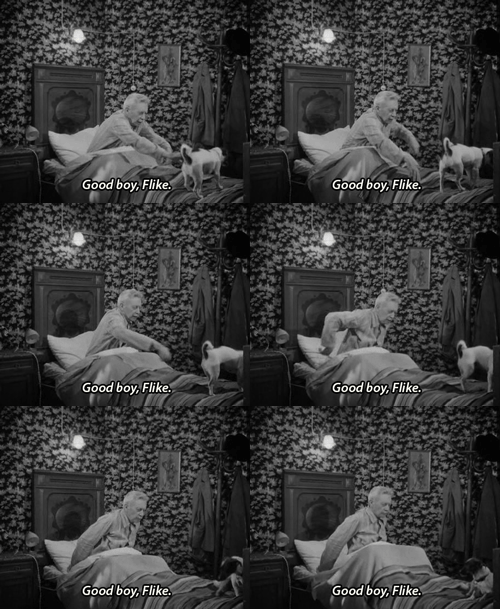
Flicke was the most loyal dog I have ever seen in my entire life. I mean it sounds like I’m over-exaggerating things but that’s just the way it is. As someone who grew up wanting to have a dog, it warmed my heart to see how much he loved Umberto and how he would go through such lengths just to be with his owner. He was so loyal, I wanted one too.
Maria, probably Umberto’s only human friend and despite their age gap created a bond like no other. They understood their feelings and one thing the two have in common is that they were both tough in different angles. In the film, Maria proved his love for Umberto and maybe even treated him like his own father and vice versa.
My least favorite part of the film was somewhere in the ending. It was the part where Umberto was standing, Flicke by his side, while waiting for the train. The scene was such a hard pill to swallow to the point that it hits home. It was such a sensitive topic, for me. A lot of thoughts were running inside my mind while watching that particular scene. It was so painful to watch and I would be lying if I say that it didn’t bother me.
My most favorite part of the film was when Flicke went missing (not that it’s my favorite part because he went missing, no) and Umberto didn’t know what to do and where to look at. The scene mainly shows how much he loves and adores his dog and how much he’s willing to risk everything just to find, be with him and hold him. Their reunion was so painful yet so beautiful to watch.
To answer my question, how can someone still smile even if things are falling apart? I must say that Flicke is Umberto’s greatest source of happiness maybe even his only source. Dogs are like people, they know everything even when something’s wrong.One thing’s for sure, Umberto didn’t want Flicke to worry and that’s what makes their relationship so breathtakingly beautiful.
Also before I end it, fun fact!! Did you know that de Sica casted non-professionals for the lead roles? To be honest, it was a great risk but he managed to pull everything off and the characters were beautifully chosen and still nailed their scenes. Kudos!
The film didn’t need any kind of effects just to relay the message of the film. It was raw and real and that’s what makes it depressingly brilliant.
“Poverty is the worst form of violence.” -Mahatma Gandhi
Umberto D is an Italian film directed by neorealist, Vittorio De Sica. It has a running time of 89 minutes and was released in Italy in January of 1952 and in the United States on November 1955. In 2005, this film was listed in TIME magazine’s “All-Time 100 Movies”—which in my opinion is a good enough reason to see it.
I’d like to start by saying how much I appreciate watching old films, it gives me an idea of what times were like before and how there are still so many similarities to today. Although the film is in Italian, is black and white, and was from 66 years ago, it’s still pretty relatable from dogs being man’s best friend to financial and economic issues, and the poor being taken advantage of by the rich.
This film showed situations that, I imagine, are totally heartbreaking to watch.
The part where Umberto lost his dog and went to the animal rescue center was a pretty depressing scene. I felt bad for the man who couldn’t afford to retrieve his pet—how must that feel? It must be so soul crushing, I was just watching it and I couldn’t even bear the pain in the man’s eyes when he realizes he wouldn’t be able to save his best friend.
Umberto walking in the city to see his old friend and tell him about his money problems only to have his friend ditch the topic and ride the bus, it was like he couldn’t leave fast enough. I think in that scene Umberto realized he couldn’t count on anyone but himself (and Flike).
I understand that money doesn’t buy happiness but it does help with making life easier and a little more comfortable. It’s people like Umberto who I look up to, they do not have much but still have so much kindness.
I would recommend this film not only to dog lovers but for people who are like me—privileged. I’m not saying this to brag but Umberto D allowed me to remember how lucky I am with the life I live. I have never worried about my next meal, let alone my dogs, I have never wondered where I would lay my head to rest, or about what I would do if I were ill. This is a film that opens your eyes to the nightmare that some people have gone through or are still going through. It’s amazing to me how there are so many varieties of life on Earth.
Overall, this isn’t a film you would watch to laugh or feel good.This film is meant to enlighten us on how devastatingly hard it is to get out of poverty and to stay in it. I can only compare Umberto’s situation to the dogs being burned alive in the rescue center—pain, pain, pain then death.
If the misery of our poor be caused not by the laws of nature, but by our institutions, great is our sin.”
Genre: Drama Director: Vittorio De Sica Screenplay: Cesare Zavattini & Vittorio De Sica Initial Relsease: 20 January 1952 (Italy) Running Time: 89 minutes
The film entirely follows Umberto Ferrari, a pensioner as he struggles his way in finding enough money to sustain his needs. Many of which is his rent for a room where he stays with his dog Flike and befriends Maria, the apartment’s housemaid. The landlady harshly demands him to pay his monthly dues before she is forced to evict him.
The film possesses a sense of sadness as we put ourselves in Umberto’s shoes. De Sica and Zavattini did a brilliant job in making the audience feel for Umberto. The overall feel made watchers follow his daily routine and sympathize with him at the same time greatly because these situations transpire in real life conditions. From being evicted from his room to reuniting with his dog, each scene was packed with tear jerking emotions that made the audience anticipate Umberto’s solace. This Italian neorealist film goes on by being thought provoking by touching the audience. It is so powerful that it is difficult not to be moved by the character’s emotions. Amidst the depressing state of the film, watchers are attached to it because of the light and slightly comedic exchange of words of characters mostly in scenes that feature Umberto and Maria. That is why I have come to a conclusion that Battisti gave justice to the role given that this is his first lead on screen appearance.
The narrative offered an exceptional story flow. As the film progressed, we get to see more of the daily happenings which made viewers understand why things go the way they were going. To add life to the tale, scenes are mostly set in the boarding house and the rest of the city almost as if we were beside Umberto from start to end.
Looking at the moralistic side, the film contained many lessons to live by. Above all, it taught the audience the value of friendship as we see Umberto’s strong relationship with Flike amidst the hardships he is dealing with. Moreover, the film is filled with actual and raw issues. One of the many would be poverty, the central theme of the movie where he fails to come up with fifteen thousand lire for rent even after selling some of his belongings in the busy streets of Rome and how he struggles to make ends meet. To think that he even forcefully got himself admitted to a hospital to survive a few days with adequate amount of food and medicine. Truly, penury was a great struggle in this movie since Umberto was not the only one who had to face it. This could be seen in the start of the movie where pensioners gathered in the street to form a demonstration to fight for their rights.
Although the ending of the film where he decides to end his life with Flike was hard to watch, it establishes the concept of companionship—that even though things get rough, they face things with the other by their side.
“As long as poverty, injustice, and gross inequality persist in our world, none of us can truly rest.”
—Nelson Mandela
\
This film entitled Umberto D. is one of the best Italian neorealist films directed by Vittorio De Sica. It focuses on the struggle of an old man striving to pay his debt to the landlady who was very rude and mean to him. However, having his dog by his side, Umberto was able to remind himself the beauty and essence of life.
Technically speaking, on the other hand, medium shot was established as well when Flike was heading towards the children. In this scene, Umberto was staring to them sadly as he sees the excitement to Flike’s face, but Umberto decided to just walk away and that was when a long shot was being slowly established. Personally, I can say that the long shot conveyed the distance that Umberto has developed between Flike and other people. Also, one of my observations while watching the film was the close up shots where Umberto attempted to commit suicide with his dog—Flike. During that scene, the music transitioning was from horrific to cheery, displaying Umberto’s struggle to prevail his hopeful heart. Umberto’s hindrances most especially his struggle to pay his rent reflects the poverty present during the mid 1900’s.
During this time, Italy was involved in World War I and film productions adapted the idea of sadistic and depressing conditions of people, taking away the faith of average citizens who were striving to survive that time. Similarly, Umberto faces many challenges as he aims to retain his dignity and save his home at the same time. He sold some of his possessions including his watch ti keep his home. However, the landlady refused to take his money, and decided to destroy his room instead. The film was realistic in nature since it exhibits the struggle with poverty which can be encountered by an average citizen. The long shots used in the scenes envisions death, but it helped us see the sense of distance between Umberto and his desire to live, to keep his home, to preserve the life he has.
But above all, I have come to realize that we never really understand a person until we consider things from their point of view.
Director: Guillermo Del Toro Genre: Fantasy, Drama Release Date: 11 October 2006
Fantasy is a genre that draws things that would never happen in the world nor would never exist in this world, but the reason why fantasy is loved all over the world is truly shown in this film. Director Guillermo Del Toro, he is a Mexican director, producer, screenwriter, novelist, known as genius of imagination where he puts heavy source into fantasy. He also produced well known films like Hellboy, Blade 2 and today’s reviewed film Pan’s Labyrinth ,which he was awarded at ” Saturn Awards , British Academy Film Awards and National Society of Film Critics Awards”. In Pan’s Labyrinth, you will definitely feel your five senses are responding rapidly.
In 1944, in the time of the Spanish civil war, rebellions and government troops continued to pursuit, Ofelia our main character and her mother moves to the place where Ofelia’s step father Vidal is. However Vidal only cares about his unborn son and treats Ofelia and her mother cold as an ice. Ofelia had to deal with Vidal’s coercive and violent attitude and in this fear fairy comes and leads her into a cave with a mysterious maze. Where Ofelia met Pan. Pan told Ofelia that she was actually a princess of the underground fairy kingdom, and she missed the sun and the sky and came to the human world, lost her memory and now she is living like a human. In order to be a princess of the fairy kingdom again, Ofelia must fulfill three duties, and Ofelia, who wanted to escape from this terrible place, accepts the mission. While fulfilling the mission, mystery characters and things happen in the real life. I hoped the film ends in happy ending but sadly it ended tragically but somehow beautifully (Saying in the fantasy life of Ofelia).
Mystery Character
Mystery things
Mystery creature
Ofelia meets Pan
The characters in the story was very impressive, Ofelia (Ivana Baquero) showed the aestheticism of Spanish actress and gave strong impression even though she was young. Vidal (Seregi Lopez), a villainous villain, he showed a charismatic villain without a sudden change of emotions, but rather a witty expression and ambivalence. This film I felt is pure perfect imagination of Guillermo Del Toro,the director, who has unleashed his own comic and bizarre imagination, differing from previous fantasy movies in Hollywood. The film is contains horror and sensational scene and it truly broke the barrier of “Fantasy if for Children”.
I was most impressed in the way of putting fantasy in the story. The genre of this film is considered fantasy but it is connected with reality. This joyful imagination in this movie is not the most important thing and I know it’s ironic to say that imagination is not important in a movie that portrays a fantasy genre but the film does not attempt to focus the story of the fantasy world in all of the scenes. Once in Hogwarts, like the Harry Potter series, the passage to the outside world is not blocked nor the story is made in a purely virtual world without reality at all, like the Lord of the Rings series. Pan’s Labyrinth, while turning my eyes to the fantasy world, it makes me to pay attention to the reality with almost equal weight. just like the role of chalk through the door to the imaginary world., the boundaries between reality and fantasy in this movie are often cut off and connected at any time.
(Ofelia going in to a world through the door drawn by magical Chalk)
Also, the reality of Ofelia, which is turning its attention to this film perhaps more than the world of fantasy, is terribly in the middle of the Spanish civil war. Fore me, As the film focuses on the reality, the film shows a lot of the violent violence and slaughter of humans appearing at times of war. Beer bottles are used to crush the innocent peasants noses and make the human body fall into disuse. In the midst of a war that solves everything with no countermeasures of violence without the slightest humanity, the appearance of the unruly people contrasts with the fantasy world in which Ofelia is performing her mission made me more serious and somehow sad.
You’re getting older, and you’ll see that life isn’t like your fairy tales. The world is a cruel place. And you’ll learn that, even if it hurts.
The more unfortunate fact that I have realize is, the quote from Ofelia’s mother is true and it is shown in the film. Apart from the mind of Ofelia, who is struggling to fulfill her mission and escape from reality, the reality becomes increasingly terrible and dark. Yes, at the end the reality become peaceful and ends by killing Vidal, but that part, Ofelia couldn’t feel or experience in the breath. I believe just as the world is threatening to burden even more if it does not rely on fantasy. But even if you rely on fantasy, you end up in reality, and it will not last forever unless you die. Where at the end of the film, Ofelia died tragically but ended with happy ending in her fantasy world.
So, despite the fact that this film is a fantasy film, my heart is pushed and I felt depressed and sad. The reality of Ofelia really made her, actually forced her to believe in the fantasy world where it became only way to get rid of the reality. The door of fantasy, which was not stronger than I have thought (I beleived that fantasy world will really save Ofelia, bringing her to happy reality), brought Ofelia back to cold reality.
This film didn’t just make me to stimulate my imagination based from the genre “Fantasy”. For me it showed the harsh reality that fantasy is needed when you want to handle a bit of reality
It is a great movie and I would like to share with other people. Fantasy is not always shown as the way you imagine.
Heartwarming, raw, and real- this motion picture is timeless.
Credit: Google
By Charmaine Quizon
Director: Vittorio De Sica Screenplay: Cesare Zavattin Release Date: 20 January 1952 (Italy); 7 November 1955 (USA) Running time: 89 minutes
One classic movie whose lead character is portrayed by a non-professional actor is a masterpiece worth to watch. We credit Umberto D to the neorealist movement that popularized characters played by ordinary folks, which location is in real-world setting and aims to manifest the reality of various societal problems. Umberto D is an epitome of this movement. This is a slice of life that reflects truth and reality. The film’s authenticity shall surely melt your heart.
Group of retired men in advanced years restlessly marching towards the government office and demanding for an increase on their pension are impeded and dispersed by apathetic police officers. Umberto Domenico Ferrari is amidst them, our protagonist. This is how the film began. And that particular scene brings sudden surge of sympathy to Umberto compelling audience to know him more and his dignified character.
This film was released in 1952 under the direction of an award-winning neorealist Vittorio De Sica and screenplay is by Cesare Zavattin. The dyad makes a great team as seen in their previous collaboration with other brilliant films such as Sciuscià in 1946 (Shoeshine), Ladri di biciclette in 1948 (The Bicycle Thief), and Miracolo a Milano in 1951 (Miracle in Milan).
To get amused or get inspired is why I gaze on the screen. And I utterly experienced both in the film Umberto D. This motion picture is one-of-a-kind. It is not just a story of an aged man with no to little means to sustain his daily needs. It is far more than an emotional experience. It is a story of amity without conditions, not in human-centric way but with an animal. He is Flike, a dog. The film’s narrative of reality is without presumptions. The shots are seamless. Although the protagonist is in a seemingly grief-stricken situation with nobody to aid him, he tries to stay focused on coming up with resolution to his dilemma. Spectators could certainly relate to Umberto Domenico Ferrari’s character. You may not be lacking money but once in your life, you had an impediment that seemed daunting but you still choose to remain positive because that is human nature after all-to never give up amidst all the difficulty. Umberto as played by a non-professional actor benefits the movie. Carlo Battisti, in real life, was a professor of Linguistic. His raw acting performance is believable. Some of his scenes have no dialogue involved but only action. His eyes speak what no words could utter. Even in the most distressing part of his life, he refused to depend and beg. What a dignity to take pride, or is it? His respectable character is more important for him than his needs.
The movie possesses the defining feature of neorealism- the on-location shooting. This adds to the experience we could get in the movie. Most scenes were shot on the street and in an old apartment. The film is not limited to Umberto’s problem. His friend Maria, a maid, also faces a predicament. She might be kicked out from her job if Antonio Belloni, the landlady, learns her pregnancy plus her struggle of knowing who the father might be of her child. Yet, this film is not all drama. It also has some amusing part- the ones with Flike in it. Flike, his friend. His character symbolizes dogs’ loyalty to their master. When he starts to fetch and stand on his hind legs, it cheers up Umberto’s character. Here, we visualize a role pets play, a companion to their masters.
And oh, the last part is exceptional. Just when you thought you had enough on Flike’s loyalty to Umberto when he was found under the footbridge, the next scene is overwhelming. The fear Flike showed is authentic. He squirms in dread and his eyes are captivating.
This film induces emotion you’d never think to experience. It’s a sure great movie to watch. It may be old but gold.
Directed, produced and written by none other than Neorealist, Vittorio De Sica in 1952. It is the type of film that’s start with small but as the film progress, you eventually see the bigger picture of its plot at the end of it. Umberto Domenico Ferrari is a retired civil servant that clings to his monthly pension for food, rent, and needs of his dog named Fike. Unable to pay for his rent in a small room where he lives for almost three decades, he was given a notice for eviction. He found sympathy with the maid of his landlady which she also has problems of her own; she’s three months pregnant and she doesn’t know who is the father. A bit ill, Umberto decided to get himself admitted to a hospital. A few days later he was feeling great, he then returns to his apartment where he found construction men renovating the place, he also found out that his landlady is getting married. He then realized Fike was missing, then he went to the city pound, then found him it amended his sad feeling for that day. After doing things that can raise money, he then realized he cannot go back to his old lifestyle. He contemplates suicide. And did not go through it because he thinks of Fike, that who would take care of his beloved dog.
It needs more to show how Umberto really fought for the raise of his pension with his co-elderly people.Which he can affect the viewers of this film to fight with dignity and with a good reason. This just focused on just a single person’s life or single point of view of how he deals with his little pension that he gets from the government. They should’ve pictured this film how they can have a voice within their government; that the government listens to it people. And how the government thinks of the wellness of it people and how to fight the main societal problem which is poverty.
It is sentimental, depressing, raw, and an eye-opener.
All in all this film is a must watch by the reason it is still relevant up to this day. It depicts what is real, accurate, and depiction of reality. That poverty is a part of the society that we cannot yet solve and also the low value of pension of the elderly which just can cover their food how about the everything that they need in between.






 collision of ideas